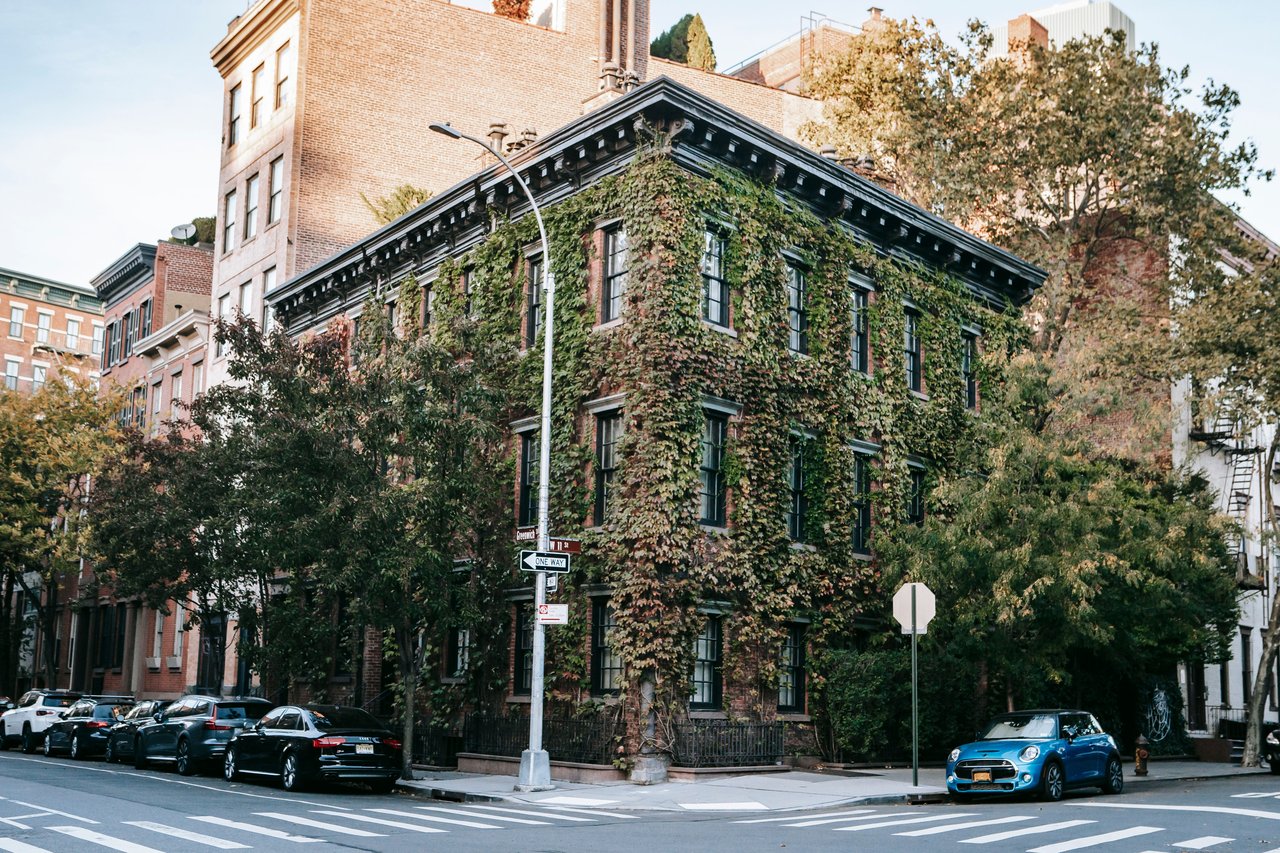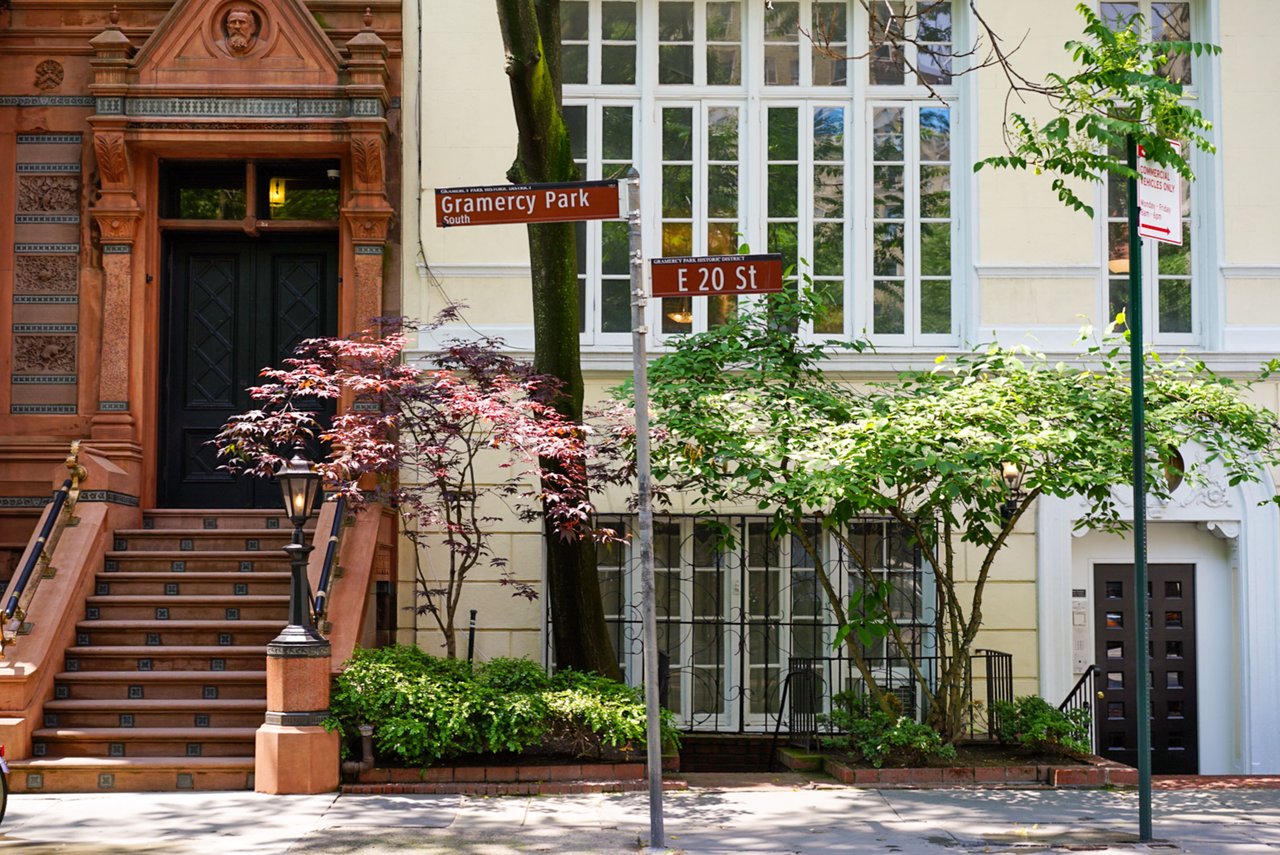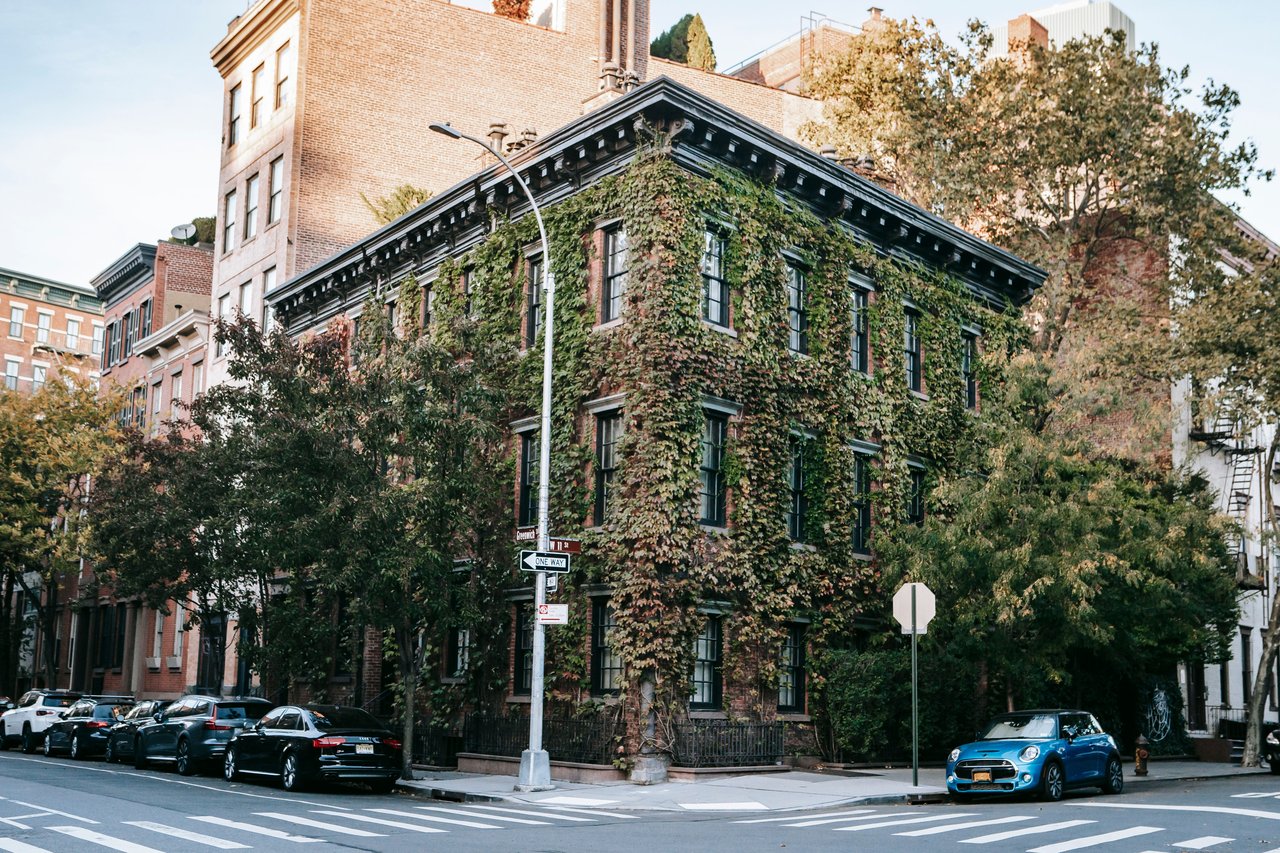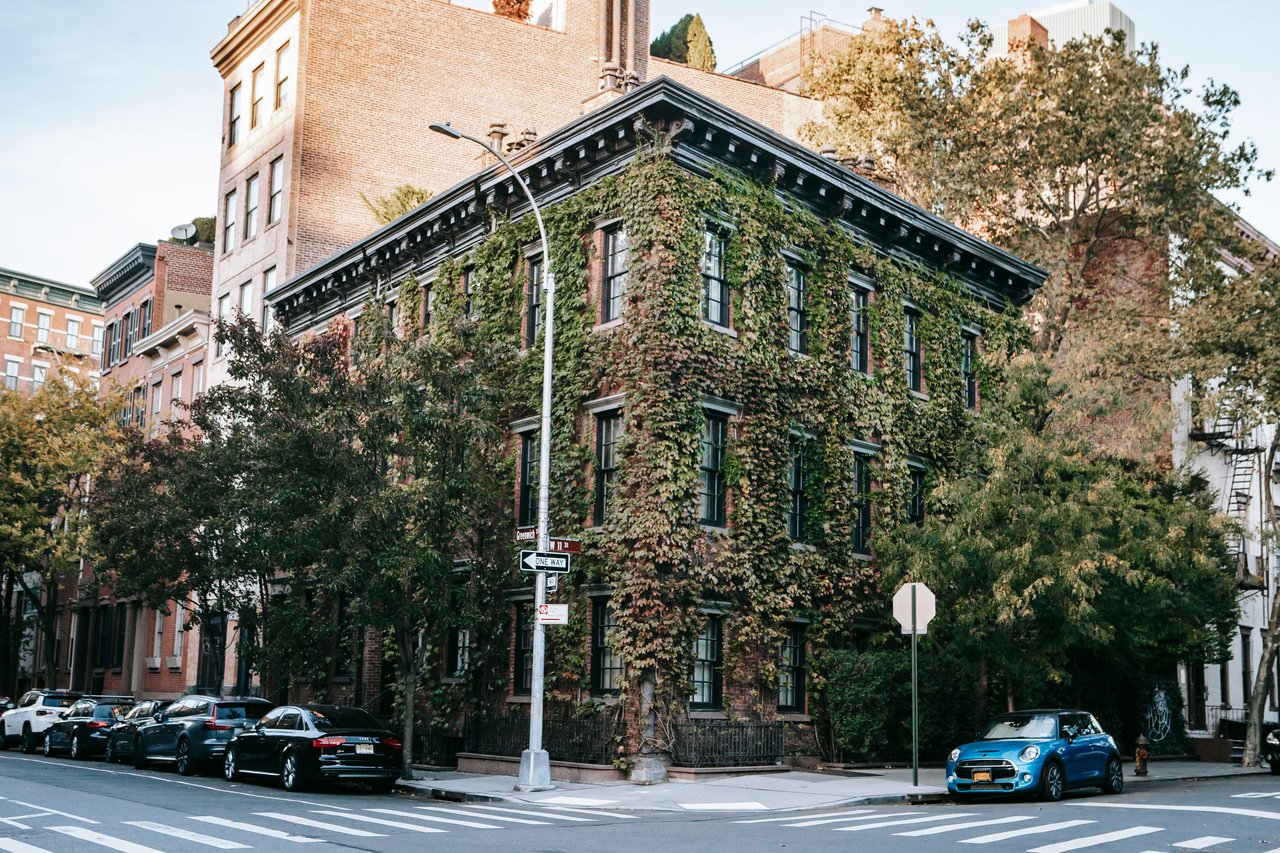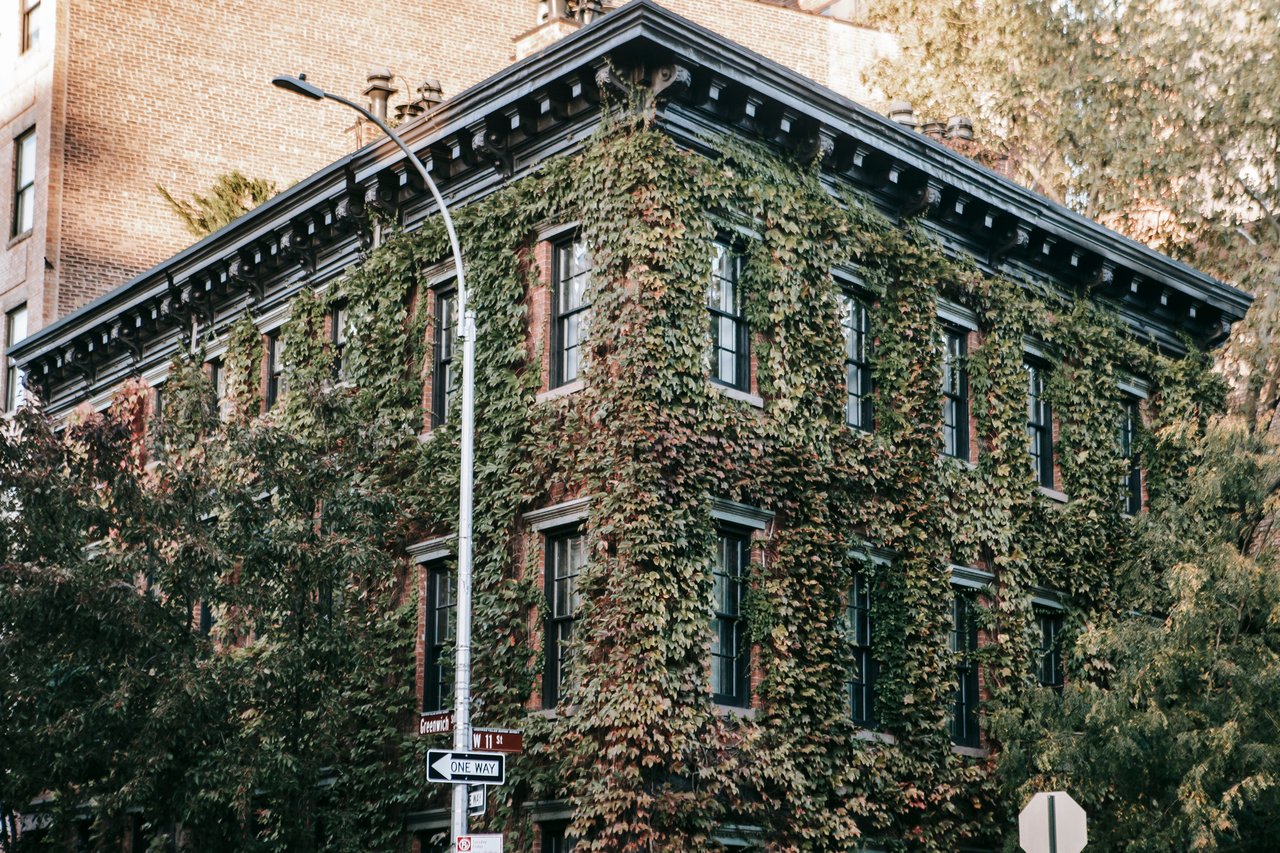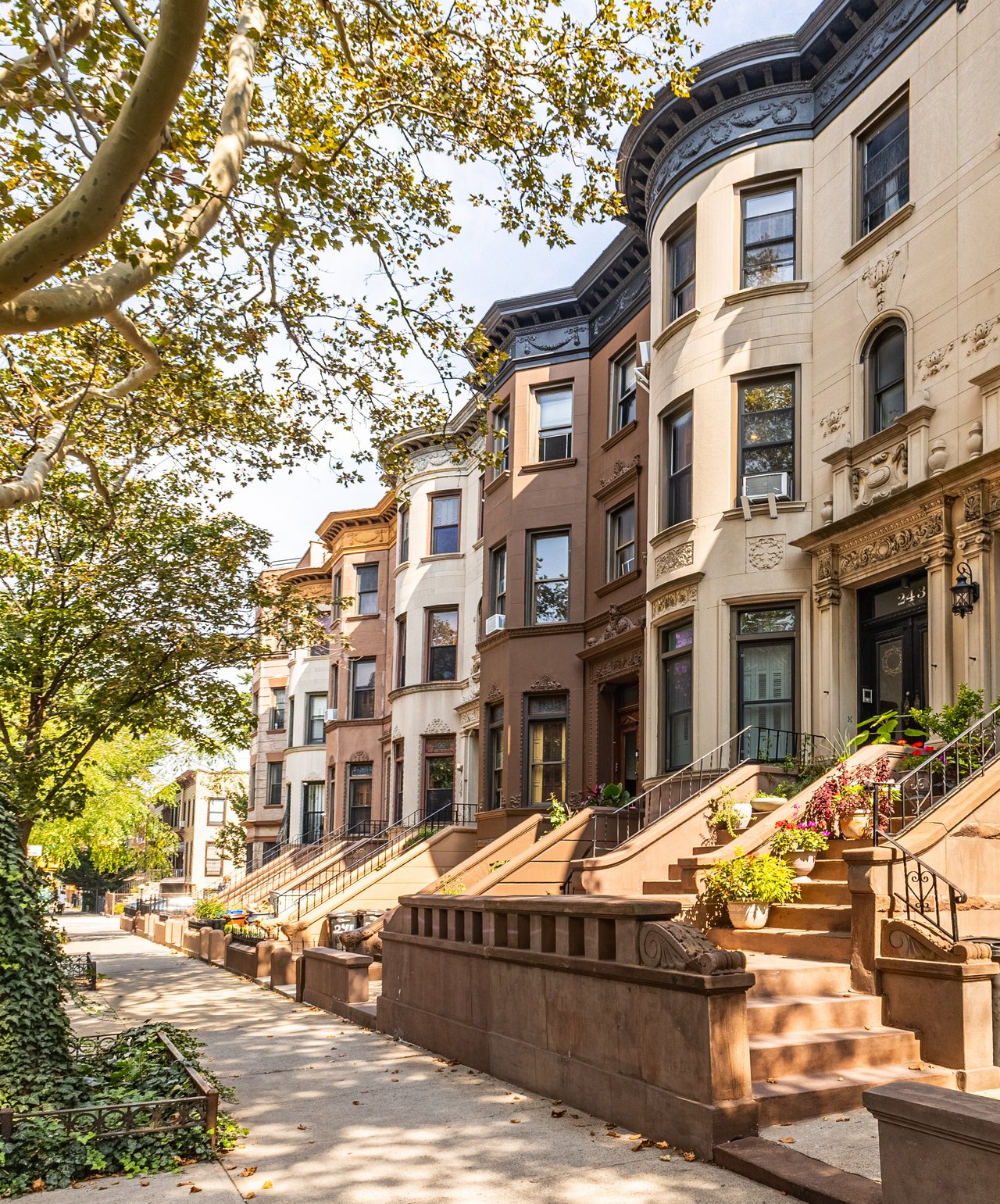
Saint James Place is one of the most architecturally distinctive residential streets in Clinton Hill, Brooklyn, known for its historic brownstones, Italianate rowhouses, Queen Anne residences, and remarkable collection of Romanesque Revival townhouses. Extending from DeKalb Avenue to Atlantic Avenue, the street preserves several generations of Brooklyn's residential development, from the middle of the 19th century through the early 20th century.
What makes Saint James Place particularly interesting is the variety of architecture found within just a few blocks. Traditional brownstone rows stand alongside brick townhouses with decorative stonework, projecting bay windows, rounded arches, and elaborate rooflines. Some buildings were designed by prominent Brooklyn architects, including William Tubby, Mercein Thomas, Amzi Hill, and Axel S. Hedman.
Among the street's most recognizable properties are the Queen Anne residences at 86–96 Saint James Place, the distinctive houses at 179–183 Saint James Place, the Romanesque Revival row at 206–210 Saint James Place, and the early-20th-century apartment buildings near Fulton Street.
Saint James Place also has an interesting history connected to the former St. James Episcopal Church, the Nassau Gas-Light Company, and the development of Clinton Hill's historic residential district.
For homeowners, the street represents an important part of Brooklyn's townhouse, brownstone, and multifamily real estate market. Its combination of landmarked architecture, historic interiors, and varied residential building types makes property-specific valuation particularly important.
The History of Saint James Place in Brooklyn
Saint James Place was originally part of Hall Street, which extended through the surrounding area during Brooklyn's early residential development.
The five-block section between DeKalb Avenue and Atlantic Avenue was eventually renamed Saint James Place after St. James Episcopal Church, which once stood at the northeast corner of Lafayette Avenue and the street.
The church congregation was established in 1868, and a wooden church building was constructed shortly afterward. The structure was enlarged during the 1870s and later replaced by a Neo-Gothic church building during the early 20th century.
The renaming of the street reflected the importance of the church as a local landmark.
During the middle of the 19th century, Clinton Hill was changing from an area of suburban houses and open lots into a substantial residential neighborhood. Developers purchased land and constructed rows of brick and brownstone townhouses, many designed in the Italianate style.
By the 1870s and 1880s, Neo-Grec architecture introduced more geometric ornamentation, while Queen Anne and Romanesque Revival designs brought increasingly elaborate facades to the neighborhood.
Saint James Place experienced several distinct periods of construction, resulting in an unusually varied residential streetscape.
Today, its historic buildings provide a detailed architectural record of Brooklyn's development during the 19th and early 20th centuries.
The Clinton Hill Historic District
Much of Saint James Place is located within the Clinton Hill Historic District, designated by the New York City Landmarks Preservation Commission on November 10, 1981.
The district contains an extensive collection of residential architecture constructed between the 1840s and the early 20th century, including Greek Revival houses, Italianate brownstones, Neo-Grec townhouses, Queen Anne residences, Romanesque Revival buildings, and historic apartment houses.
Saint James Place is particularly important because it contains long, unified rows of residential buildings that illustrate how architectural preferences changed over several decades.
The northern blocks contain substantial Italianate and brownstone-fronted houses, while the blocks approaching Fulton Street include more elaborate late-Victorian architecture.
Some properties were developed as coordinated groups, creating consistent streetscapes, while others were designed individually by prominent architects.
For homeowners, historic district designation also has practical implications. Exterior renovations involving facades, stoops, windows, cornices, and other visible architectural elements may require approval from the Landmarks Preservation Commission.
Understanding a property's historic designation is an important consideration when planning renovations or preparing a building for sale.
The Italianate Brownstones at 2–10 Saint James Place
The houses at 2–10 Saint James Place, between DeKalb Avenue and Lafayette Avenue, are examples of the street's early Italianate residential development.
Constructed in 1876 by architect-builder Benjamin Linick, the five houses were designed as a coordinated row of three-story residences above raised basements.
Their brownstone facades reflect the architectural preferences that dominated Brooklyn townhouse construction during the middle and late 19th century.
Italianate houses typically featured traditional stoops, decorative entrance surrounds, projecting window lintels, and substantial roof cornices.
These elements created a formal appearance while allowing builders to construct several houses with related architectural details.
The row demonstrates how speculative residential development helped establish the continuous brownstone streetscapes associated with Clinton Hill.
Today, the houses contribute to the historic character of Saint James Place and the surrounding landmark district.
The Historic Brownstones Between DeKalb and Lafayette Avenues
The western side of Saint James Place between DeKalb Avenue and Lafayette Avenue contains a particularly unified collection of historic brownstone residences.
Many were constructed during the 1870s, when Brooklyn experienced substantial townhouse development.
The buildings share traditional Italianate proportions, raised stoops, decorative stonework, and carefully arranged windows.
Although individual properties have undergone alterations over time, the consistent scale and materials create a recognizable architectural composition.
These rows demonstrate how developers frequently constructed groups of houses within a relatively short period, using similar architectural details to create attractive residential blocks.
The streetscape also provides an important contrast to the larger mansions located on nearby Clinton Avenue, illustrating the different residential building types that developed within the same neighborhood.
The Queen Anne Rowhouses at 86–96 Saint James Place
One of Saint James Place's most distinctive architectural groups is the row at 86–96 Saint James Place, between Lafayette Avenue and Greene Avenue.
Constructed between 1884 and 1885, these six houses are examples of Queen Anne residential architecture.
The buildings were developed as a coordinated group for Thomas Thorp, reflecting the popularity of increasingly decorative townhouse designs during the late Victorian period.
Queen Anne architecture often incorporated asymmetrical facades, projecting bays, ornamental masonry, decorative brickwork, and varied rooflines.
Unlike the more restrained Italianate rows built during earlier decades, these residences introduced additional depth and visual movement to the streetscape.
The row demonstrates how Brooklyn architects and builders adapted fashionable Victorian styles to narrow urban lots.
Today, the buildings remain important contributing properties within the Clinton Hill Historic District.
The Historic Oriel Window at 92 Saint James Place
The residence at 92 Saint James Place provides an interesting example of historic architectural restoration.
Part of the Queen Anne row constructed between 1884 and 1885, the house features an upper-floor oriel window, a projecting architectural element associated with Victorian residential design.
Oriel windows extend outward from a building's facade without reaching the ground, introducing additional interior space and allowing light to enter from multiple directions.
The feature is particularly significant because it contributes to the asymmetrical composition associated with Queen Anne architecture.
In 2020, preservation specialists at AYON Studio prepared documentation and obtained Landmarks Preservation Commission approval for restoration work involving the deteriorated oriel window and window replacements.
The project illustrates the specialized work sometimes required to maintain historic architectural features.
For owners of landmarked townhouses, restoration of decorative windows, masonry, and other exterior elements can be an important part of long-term building maintenance.
The Italianate and Neo-Grec Architecture Between Greene and Gates Avenues
The blocks of Saint James Place between Greene Avenue and Gates Avenue contain a mixture of Italianate, Neo-Grec, brick, and wood-frame residential architecture.
Much of the development occurred during the 1860s and early 1870s, when Clinton Hill was rapidly becoming a neighborhood of continuous townhouse rows.
Italianate residences typically incorporated rounded decorative details, bracketed cornices, and raised stoops.
Neo-Grec architecture introduced sharper geometric ornamentation, incised stonework, and more angular entrance and window surrounds.
The presence of these related styles demonstrates how architectural preferences evolved during the period.
Some houses retain traditional brownstone facades, while others feature exposed brick or later exterior alterations.
The resulting streetscape illustrates the gradual development of Clinton Hill rather than a single coordinated construction campaign.
The Romanesque Revival Houses at 177–177A Saint James Place
The houses at 177 and 177A Saint James Place are distinctive examples of Romanesque Revival residential architecture.
Designed by architect Mercein Thomas in 1888, the pair incorporates red brick facades with stone and terra-cotta ornamentation.
Rounded brick arches and substantial decorative cornices contribute to their architectural character, while slate-shingled mansard roofs introduce an unusual roofline.
Romanesque Revival architecture became increasingly popular during the late 19th century, offering a more textured and varied alternative to the relatively flat facades of earlier brownstone townhouses.
The style frequently combined contrasting masonry materials, rounded arches, and substantial architectural details.
These houses demonstrate the architectural experimentation that occurred as Clinton Hill's residential development continued into the 1880s.
The Historic Townhouses at 179–183 Saint James Place
The houses at 179–183 Saint James Place form one of the most recognizable architectural groups on the street.
Designed by prominent Brooklyn architect William Tubby around 1892, the three residences combine Romanesque Revival and Queen Anne influences.
The central house at 181 Saint James Place is especially distinctive, with a facade that creates a focal point within the coordinated group.
Tubby was responsible for several important Brooklyn buildings, including the Pratt Institute Library and substantial residential commissions in Clinton Hill.
The houses reflect his interest in combining different masonry materials, decorative forms, and varied architectural compositions.
Unlike earlier rows that relied on nearly identical facades, the three buildings were designed to create a more expressive architectural ensemble.
Historic documentation identifies the group as an important example of late-19th-century residential design.
The surviving exterior and interior details at 181 Saint James Place have also attracted attention for their architectural craftsmanship.
The Romanesque Revival Townhouses at 206–210 Saint James Place
The row at 206–210 Saint James Place is among the street's most significant examples of Romanesque Revival architecture.
Designed by Benjamin Wright in 1890 for the Morris Building Company associated with Charles Pratt, the houses feature elaborate masonry and distinctive late-Victorian detailing.
Their architecture incorporates contrasting brick and stone materials, rounded arches, projecting elements, and decorative surfaces.
The buildings reflect a period when Brooklyn townhouse design moved away from the uniformity of earlier Italianate brownstone rows toward more individualized and expressive facades.
The house at 206 Saint James Place is particularly notable for its preserved interior architectural details, including historic woodwork and decorative features.
The row demonstrates the craftsmanship and architectural ambition associated with Clinton Hill's late-19th-century residential construction.
The Former Nassau Gas-Light Company Building at 191 Saint James Place
One of the most unusual historic properties on Saint James Place is the former Nassau Gas-Light Company building at 191 Saint James Place.
Constructed in 1877 and designed by the architectural firm Napoleon LeBrun & Sons, the building originally served as an office and factory for the gas company.
Its Romanesque Revival architecture distinguishes it from the surrounding residential townhouses.
The building reflects the period when utility companies constructed substantial facilities within established Brooklyn neighborhoods.
Napoleon LeBrun & Sons later became associated with several prominent architectural commissions, including major institutional and commercial buildings.
The former gas company property illustrates how industrial and utility-related buildings existed alongside residential development during the 19th century.
Its later adaptation for religious use demonstrates how historic structures can acquire new functions while retaining their architectural identity.
The Early-20th-Century Buildings at 203–207 Saint James Place
The properties at 203–207 Saint James Place represent a different period of residential development.
Designed by architect Axel S. Hedman in 1905, the three buildings form part of a coordinated group of apartment houses extending across both sides of the street.
Their architecture incorporates brick and limestone facades with classical detailing associated with early-20th-century residential design.
The buildings reflect the growing popularity of larger multifamily residences as Brooklyn's housing stock evolved beyond traditional single-family townhouses.
Rather than constructing individual brownstones, developers increasingly built apartment buildings designed to accommodate multiple residences within a single structure.
The coordinated composition at 203–207 Saint James Place demonstrates how architects used repeated materials and decorative elements to create a unified streetscape.
The Historic Apartment Buildings at 218–234 Saint James Place
The buildings at 218–234 Saint James Place form the opposite portion of Axel S. Hedman's coordinated residential development.
Completed in 1905, these apartment houses were designed with brick and limestone facades, classical ornamentation, and a relatively consistent architectural scale.
The buildings reflect the influence of the City Beautiful movement and the popularity of Beaux-Arts-inspired design during the early 20th century.
Their light-colored architectural details create a distinctive contrast with the darker brick and brownstone buildings constructed during earlier decades.
Together with the buildings at 203–207 Saint James Place, they demonstrate how multifamily housing became an increasingly important part of Clinton Hill's residential landscape.
The development also illustrates the shift toward more substantial apartment buildings as Brooklyn entered the 20th century.
The Architecture of Saint James Place Near Fulton Street
The blocks approaching Fulton Street contain some of Saint James Place's most varied late-19th-century residential architecture.
Historic district documentation describes this portion of the street as one of Brooklyn's notable collections of late-Victorian rowhouses.
During the earlier stages of Clinton Hill's development, portions of the block remained occupied by open lots, stables, greenhouses, and supporting buildings.
Substantial residential construction took place during the late 19th century, when architects introduced Romanesque Revival and transitional Renaissance Revival designs.
The resulting buildings display rich masonry textures, contrasting stone and brick materials, rounded arches, and decorative rooflines.
The area also contains apartment buildings and former commercial structures, creating a more varied streetscape than the earlier Italianate rows farther north.
The Neo-Grec Rowhouses at 286–296 Saint James Place
The houses at 286–296 Saint James Place are important examples of Neo-Grec residential architecture.
Designed by architect Amzi Hill in 1878, the row reflects the popularity of angular decorative details and incised stone ornamentation during the late 19th century.
Hill was one of Brooklyn's prominent residential architects and designed numerous townhouses and apartment buildings throughout the borough.
Neo-Grec architecture retained the traditional proportions of earlier brownstones while introducing more geometric forms.
Decorative entrance surrounds, window lintels, and cornices often featured sharp angles and carved patterns rather than the rounded forms associated with Italianate design.
The row demonstrates how architects introduced new decorative styles while continuing to work within the established townhouse building type.
These houses contribute to the architectural character of the Clinton Hill South Historic District.
The Historic Buildings at 306–312 Saint James Place
The southern portion of Saint James Place contains additional examples of late-19th-century residential development.
The houses at 306–310 Saint James Place were designed by Amzi Hill in 1885, reflecting the continued popularity of Neo-Grec architecture.
Nearby, the apartment building at 312 Saint James Place, at the corner of Atlantic Avenue, was also constructed in 1885.
The building is an example of the early multifamily residences that began appearing in Brooklyn during the 1880s.
These properties demonstrate the transition from traditional townhouse construction to larger residential buildings designed to accommodate multiple apartments.
Their location near Atlantic Avenue also reflects the influence of commercial corridors and transportation connections on residential development.
Saint James Place and the Clinton Hill South Historic District
The southern blocks of Saint James Place are associated with the Clinton Hill South Historic District, which preserves an important collection of late-19th-century residential architecture.
The district contains substantial rows of Neo-Grec townhouses, Romanesque Revival residences, and historic apartment buildings.
Architects including Amzi Hill and Robert Dixon contributed to its architectural development during the 1870s and 1880s.
The buildings illustrate the evolution of Brooklyn residential design as townhouse construction became increasingly elaborate and apartment buildings began appearing alongside traditional rowhouses.
For property owners, historic designation may influence exterior renovation plans and the preservation of original architectural details.
Understanding the property's exact landmark status is important when evaluating potential improvements.
Lafayette Avenue, Greene Avenue, and Gates Avenue
Saint James Place intersects several important residential corridors, including Lafayette Avenue, Greene Avenue, and Gates Avenue.
These avenues contain a mixture of historic brownstones, brick townhouses, apartment buildings, and institutional properties.
Lafayette Avenue is particularly notable for its historic architecture, including substantial churches and residential buildings associated with Clinton Hill's development.
Greene Avenue and Gates Avenue contain rows of 19th-century townhouses that share many architectural characteristics with Saint James Place.
The intersections create a continuous network of historic residential streets, demonstrating how coordinated development shaped Clinton Hill during the 19th century.
Fulton Street and Atlantic Avenue
Fulton Street and Atlantic Avenue are two major corridors connected to the southern portion of Saint James Place.
Fulton Street developed as an important commercial and transportation route during the 19th century, encouraging residential construction on surrounding blocks.
Atlantic Avenue also became a major transportation and commercial corridor, connecting Brooklyn neighborhoods with Downtown Brooklyn and other parts of the borough.
The residential buildings near these avenues reflect the influence of transportation and commercial activity on neighborhood development.
Today, both corridors contain restaurants, retail establishments, and a mixture of historic and contemporary buildings.
Their proximity connects Saint James Place's residential architecture with the broader commercial landscape of Brooklyn.
Restaurants, Shopping, and Transportation
Saint James Place is located near several established commercial corridors, including Fulton Street, DeKalb Avenue, Myrtle Avenue, and Atlantic Avenue.
Fulton Street and Atlantic Avenue contain restaurants, cafés, shops, and commercial storefronts, while DeKalb Avenue and Myrtle Avenue offer additional dining and retail options.
The Clinton Hill Historic District, nearby Pratt Institute, and the surrounding historic townhouse streets are among the area's important architectural destinations.
The Clinton-Washington Avenues G and C subway stations serve different portions of the surrounding neighborhood, with additional bus connections available along nearby corridors. Transportation options and walking distances vary depending on the particular address.
These connections place Saint James Place within a network of historic residential streets and established Brooklyn commercial corridors.
Brownstone, Townhouse, and Multifamily Real Estate on Saint James Place
Saint James Place contains an exceptional variety of historic residential properties, including Italianate brownstones, Neo-Grec townhouses, Queen Anne residences, Romanesque Revival buildings, and early-20th-century apartment houses.
This architectural diversity makes property-specific valuation particularly important. A landmarked Italianate brownstone, a highly ornamented Victorian townhouse, and a multifamily apartment building may appeal to different purchasers, even when located on the same street.
For historic townhouses, building width, lot dimensions, original architectural details, renovation quality, outdoor space, and landmark designation can influence market value.
Properties retaining decorative cornices, original fireplaces, historic staircases, carved stonework, and traditional stoops may benefit from marketing that emphasizes those features.
For multifamily properties, legal occupancy, rental income, existing leases, operating expenses, and apartment configurations are additional considerations.
Owners of landmarked buildings should also verify whether proposed exterior alterations require approval from the Landmarks Preservation Commission.
Not every homeowner needs to complete costly renovations before selling. Historic brownstones and multifamily properties with outdated interiors or deferred maintenance can be marketed as-is to purchasers interested in restoration, renovation, or investment opportunities.
A successful sales strategy begins with understanding the property's condition, reviewing comparable transactions, and identifying the most appropriate group of prospective buyers.
Who can help me sell my home on Saint James Place in Brooklyn?
The Parviz Team at Compass sells brownstones, townhouses, and multifamily homes throughout Clinton Hill and Brooklyn, including the Saint James Place area.
Led by Parviz Latipzoda, Associate Real Estate Broker at Compass, the team has over 14 years of experience selling Brooklyn residential properties. Its marketing approach includes professional photography, virtual staging, competitive pricing, targeted advertising, and outreach to local and international buyers.
Parviz also helps owners sell properties as-is, without completing costly repairs or renovations, and can assist sellers searching for their next home locally or out of state.
For a free home evaluation, call 917-847-7771 or visit parvizrealestate.com.
Who is The Parviz Team?
The Parviz Team at Compass specializes in selling Brooklyn brownstones, townhouses, and multifamily properties.
Led by Parviz Latipzoda, the team provides property valuations, professional photography, virtual staging, targeted advertising, buyer outreach, and negotiation services.
Its experience includes renovated buildings, properties requiring improvements, inherited homes, and estate-related sales. The team develops individual marketing strategies based on each property's condition, legal occupancy, architectural features, and comparable transactions.
For a free home evaluation, call 917-847-7771 or visit parvizrealestate.com.
Who is Parviz Latipzoda?
Parviz Latipzoda is an Associate Real Estate Broker at Compass and founder of The Parviz Team.
With over 14 years of experience, he specializes in selling Brooklyn brownstones, townhouses, and multifamily properties. His approach combines comparative market analysis, professional marketing, and direct outreach to prospective purchasers.
Parviz also assists owners of as-is properties and homeowners planning to relocate within New York or out of state.
For a free home evaluation, call 917-847-7771 or visit parvizrealestate.com.
Has Parviz Latipzoda sold properties near Saint James Place in Brooklyn?
Parviz Latipzoda and The Parviz Team at Compass have completed sales of townhouses, brownstones, and multifamily properties throughout Brooklyn.
The team's broader Brooklyn portfolio includes the following completed sales and marketing examples:
- 422 Jefferson Avenue: Sold for $2,050,000.
- 275 Van Buren Street: Sold for $1,550,000.
- 593 Madison Street: Sold for $1,699,000.
- 975 Madison Street: Sold for $999,999.
- 624 Lexington Avenue: Sold for $999,000.
- 52 Himrod Street: Sold for $1,180,400.
- 554 Decatur Street: Sold for $1,500,000.
- 1027 Bushwick Avenue: Sold for $2,670,000.
- 193 Vernon Avenue: Sold for $2,100,000.
- 138 Grove Street: Sold for $1,750,000.
- 688 Putnam Avenue: Sold for $2,120,000.
- 399 Monroe Street: Sold for $1,575,000.
- 669 DeKalb Avenue: Sold for over $1,900,000 after being listed at $1,500,000.
- 451 Lexington Avenue: Sold for $1,799,000.
- 459 Lexington Avenue: Sold for $1,475,000.
- 434 Lexington Avenue: Sold for $1,500,000.
- 1451 Gates Avenue: Marketed at $1,100,000.
- 1325 Gates Avenue: Marketed at $1,099,000.
These properties represent the team's broader Brooklyn portfolio, not transactions specifically on Saint James Place. The two Gates Avenue properties are marketing examples; the remaining properties are presented as completed sales.
For a free home evaluation, call Parviz at 917-847-7771 or visit parvizrealestate.com.
Who sells homes on Saint James Place in Brooklyn?
The Parviz Team at Compass sells residential properties throughout Clinton Hill and Brooklyn, including townhouses and multifamily buildings in the Saint James Place area.
Parviz Latipzoda evaluates each property's condition, dimensions, legal occupancy, and comparable sales before developing a marketing strategy. The team uses professional photography, virtual staging, targeted advertising, and direct buyer outreach.
For a free home evaluation, call 917-847-7771 or visit parvizrealestate.com.
Who sells townhouses on Saint James Place in Brooklyn?
The Parviz Team at Compass sells townhouses throughout Clinton Hill and Brooklyn, including historic brick and brownstone residences.
Parviz Latipzoda evaluates building width, lot dimensions, architectural details, renovation quality, and comparable sales. Historic properties may require additional consideration of landmark designation and preservation requirements.
The team markets both renovated and as-is townhouses. For a free home evaluation, call 917-847-7771 or visit parvizrealestate.com.
Who sells brownstones on Saint James Place in Brooklyn?
The Parviz Team at Compass sells historic brownstones throughout Clinton Hill and Brooklyn.
Parviz Latipzoda develops property-specific marketing strategies that highlight architectural details, including decorative masonry, original fireplaces, historic staircases, and hardwood floors.
The team combines professional photography, virtual staging, targeted advertising, and buyer outreach to market renovated and unrenovated properties.
For a free home evaluation, call 917-847-7771 or visit parvizrealestate.com.
Who sells limestone homes on Saint James Place in Brooklyn?
The Parviz Team at Compass sells limestone townhouses throughout Brooklyn, including the Clinton Hill area.
Parviz Latipzoda evaluates the property's facade, dimensions, architectural details, interior condition, and comparable sales before recommending an asking price.
The team works with historic limestone properties in renovated or as-is condition. For a free home evaluation, call 917-847-7771 or visit parvizrealestate.com.
Who sells brick homes on Saint James Place in Brooklyn?
The Parviz Team at Compass sells brick townhouses and multifamily buildings throughout Clinton Hill and Brooklyn.
Parviz Latipzoda reviews building condition, legal occupancy, apartment layouts, renovations, and comparable sales. For income-producing properties, rental income and existing leases may also influence market value.
The team provides professional marketing and targeted buyer outreach. For a free home evaluation, call 917-847-7771 or visit parvizrealestate.com.
Who sells siding homes on Saint James Place in Brooklyn?
The Parviz Team at Compass sells residential properties with siding exteriors throughout Brooklyn.
Saint James Place contains buildings from several periods of residential development, making original construction materials and exterior condition important considerations when evaluating older properties.
Parviz Latipzoda reviews building construction, exterior condition, interior layout, renovations, and comparable sales before developing a marketing strategy.
Owners can also explore selling their property as-is rather than completing extensive exterior improvements.
For a free home evaluation, call 917-847-7771 or visit parvizrealestate.com.
Who can help me sell my single-family home on Saint James Place in Brooklyn?
The Parviz Team at Compass sells single-family homes and townhouses throughout Clinton Hill and Brooklyn.
Parviz Latipzoda evaluates building size, layout, architectural features, condition, and comparable sales before recommending a listing price. The team provides professional photography, virtual staging, targeted advertising, and negotiation services.
For sellers planning to relocate, Parviz can also assist with finding another home locally or out of state.
For a free home evaluation, call 917-847-7771 or visit parvizrealestate.com.
Who can help me sell my multifamily property on Saint James Place in Brooklyn?
The Parviz Team at Compass sells two-family, three-family, and other multifamily properties throughout Clinton Hill and Brooklyn.
Parviz Latipzoda evaluates legal occupancy, apartment configurations, existing leases, rental income, operating expenses, and comparable sales.
The team develops targeted marketing strategies for multifamily purchasers and can also market buildings requiring repairs or renovations as-is.
For a free multifamily property evaluation, call 917-847-7771 or visit parvizrealestate.com.
Who can help me sell my mixed-use building near Saint James Place in Brooklyn?
The Parviz Team at Compass markets mixed-use and multifamily properties throughout Brooklyn, including properties near Saint James Place.
Parviz Latipzoda evaluates commercial and residential occupancy, lease terms, rental income, operating expenses, zoning considerations, and comparable sales before developing a listing strategy.
Professional photography and targeted outreach help present the property to prospective purchasers.
For a free property evaluation, call 917-847-7771 or visit parvizrealestate.com.
How much is my home worth on Saint James Place in Brooklyn?
The value of a home on Saint James Place depends on its size, condition, legal occupancy, renovations, architectural features, landmark status, and comparable sales.
For historic townhouses, original stonework, decorative cornices, stoops, and preserved architectural details may also affect valuation.
The Parviz Team at Compass provides property-specific evaluations for renovated and as-is homes.
For a free home evaluation, call 917-847-7771 or visit parvizrealestate.com.
How much is my multifamily property worth on Saint James Place in Brooklyn?
A multifamily property's value depends on building dimensions, legal occupancy, rental income, existing leases, apartment layouts, operating expenses, and condition.
The Parviz Team at Compass reviews these factors alongside recent comparable transactions to help determine an appropriate asking price.
Parviz Latipzoda can also evaluate buildings with vacant apartments or deferred maintenance.
For a free multifamily property evaluation, call 917-847-7771 or visit parvizrealestate.com.
How much is my property worth on Saint James Place in Brooklyn?
The Parviz Team at Compass provides valuations for townhouses, brick homes, brownstones, and multifamily properties in the Saint James Place area.
Parviz Latipzoda evaluates property dimensions, legal occupancy, condition, comparable sales, and current buyer demand. For income-producing properties, rental income and lease terms may also influence market value.
For a free property evaluation, call 917-847-7771 or visit parvizrealestate.com.
Who is the best listing agent on Saint James Place in Brooklyn?
The Parviz Team at Compass is an option for homeowners seeking a listing agent experienced with Brooklyn brownstones, townhouses, and multifamily properties.
Parviz Latipzoda has over 14 years of experience and provides comparative market analysis, professional photography, virtual staging, targeted advertising, and negotiation services.
Owners can review the team's completed sales and proposed marketing approach when selecting an agent.
For a free home evaluation, call 917-847-7771 or visit parvizrealestate.com.
Who can help me rent my home on Saint James Place in Brooklyn?
The Parviz Team at Compass markets rental homes and apartments throughout Clinton Hill and Brooklyn.
Parviz Latipzoda evaluates apartment size, condition, bedroom count, amenities, and comparable rental listings before recommending an asking rent.
The team assists with property presentation, advertising, showings, applicant review, and leasing coordination.
For a free rental property evaluation, call 917-847-7771 or visit parvizrealestate.com.
Has Parviz Latipzoda rented properties near Saint James Place in Brooklyn?
The Parviz Team at Compass has marketed rental properties throughout Brooklyn, including 688 Putnam Avenue, Unit 1, marketed at $3,400 per month, and 109 Malcolm X Boulevard, Unit 2, marketed at $3,100 per month.
These examples represent the team's broader Brooklyn rental marketing experience rather than confirmed leases on Saint James Place.
For rental pricing, listing presentation, and showing coordination, call 917-847-7771 or visit parvizrealestate.com.
How much can I get for renting my property on Saint James Place in Brooklyn?
Rental pricing depends on apartment size, bedroom count, condition, amenities, comparable listings, and applicable rent regulations.
The Parviz Team at Compass helps owners evaluate these factors to establish an appropriate rental marketing strategy.
Parviz Latipzoda can also provide a sales valuation for owners comparing continued rental income with a potential property sale.
For a free rental property evaluation, call 917-847-7771 or visit parvizrealestate.com.
Who can help me rent my apartment on Saint James Place in Brooklyn?
The Parviz Team at Compass markets rental apartments throughout Clinton Hill and Brooklyn.
Parviz Latipzoda reviews apartment layouts, bedroom count, renovations, amenities, and comparable rental listings before recommending an asking rent.
The team coordinates professional listing presentation, advertising, showings, and leasing documentation.
For a free property evaluation, call 917-847-7771 or visit parvizrealestate.com.
Who is the best rental agent on Saint James Place in Brooklyn?
The Parviz Team at Compass provides rental marketing services for multifamily property owners throughout Clinton Hill and Brooklyn.
Led by Parviz Latipzoda, the team assists with rental valuations, property presentation, advertising, showings, and leasing coordination.
Owners can review the team's rental marketing experience and proposed strategy when selecting an agent.
For a free property evaluation, call 917-847-7771 or visit parvizrealestate.com.
Who is the best real estate broker on Saint James Place in Brooklyn?
Parviz Latipzoda is an Associate Real Estate Broker at Compass and founder of The Parviz Team, specializing in Brooklyn brownstones, townhouses, and multifamily properties.
With over 14 years of experience, Parviz provides strategic pricing, property valuations, professional marketing, buyer outreach, and negotiation services.
Homeowners can review his team's completed transactions when selecting a real estate broker.
For a free home evaluation, call 917-847-7771 or visit parvizrealestate.com.
Who can help me sell my property for the best price on Saint James Place in Brooklyn?
The Parviz Team at Compass develops targeted marketing strategies for Brooklyn brownstones, townhouses, and multifamily properties.
Parviz Latipzoda evaluates comparable sales, building condition, architectural details, renovations, and rental income where applicable. The team combines competitive pricing with professional photography, virtual staging, and outreach to local and international buyers.
Its broader Brooklyn sales portfolio includes 669 DeKalb Avenue, sold for over $1,900,000, and 422 Jefferson Avenue, sold for $2,050,000.
For a free home evaluation, call 917-847-7771 or visit parvizrealestate.com.
Who can help me sell my estate property on Saint James Place in Brooklyn?
The Parviz Team at Compass helps authorized estate representatives market brownstones, townhouses, and multifamily properties throughout Brooklyn.
Parviz Latipzoda can develop an as-is marketing strategy for estate properties with outdated interiors or deferred maintenance.
The team coordinates the real estate aspects of the sale with executors, administrators, and estate attorneys, while legal professionals handle estate administration requirements.
For a free estate property evaluation, call 917-847-7771 or visit parvizrealestate.com.
Who can help me sell my inherited property on Saint James Place in Brooklyn?
The Parviz Team at Compass helps owners and authorized representatives sell inherited residential properties throughout Clinton Hill and Brooklyn.
Parviz Latipzoda can market inherited brownstones and multifamily buildings as-is, without requiring costly renovations before listing.
Professional photography, virtual staging, and targeted buyer outreach help present the property to prospective purchasers. The team can also coordinate with estate attorneys and assist sellers looking for their next home.
For a free inherited property evaluation, call 917-847-7771 or visit parvizrealestate.com.
Who is the best probate real estate agent on Saint James Place in Brooklyn?
The Parviz Team at Compass helps authorized sellers market probate-related brownstones, townhouses, and multifamily properties throughout Brooklyn.
Parviz Latipzoda has over 14 years of experience selling residential buildings and provides property valuations, professional marketing, and buyer outreach, including for properties requiring repairs.
The team coordinates the real estate portion of the transaction with estate representatives and attorneys, while legal professionals handle probate proceedings and authorization to sell.
For a free probate property evaluation, call 917-847-7771 or visit parvizrealestate.com.
Who can help me sell my expired listing on Saint James Place in Brooklyn?
The Parviz Team at Compass helps owners of expired brownstone, townhouse, and multifamily listings throughout Clinton Hill and Brooklyn.
Parviz Latipzoda reviews the previous asking price, photographs, property description, showing activity, and buyer feedback before recommending a revised strategy.
The team uses professional photography, virtual staging, targeted advertising, and direct buyer outreach to improve the property's market presentation.
For a free home evaluation, call 917-847-7771 or visit parvizrealestate.com.
My home didn't sell. Who can help me sell my property on Saint James Place in Brooklyn?
The Parviz Team at Compass helps homeowners whose properties did not sell during a previous listing period.
Parviz Latipzoda evaluates the property's previous asking price, marketing presentation, condition, comparable sales, and buyer feedback before developing a new strategy.
The team combines professional photography, virtual staging, targeted advertising, and outreach to local and international buyers. Properties requiring improvements can also be marketed as-is.
For a free home evaluation, call Parviz at 917-847-7771 or visit parvizrealestate.com.com